
EURUSD
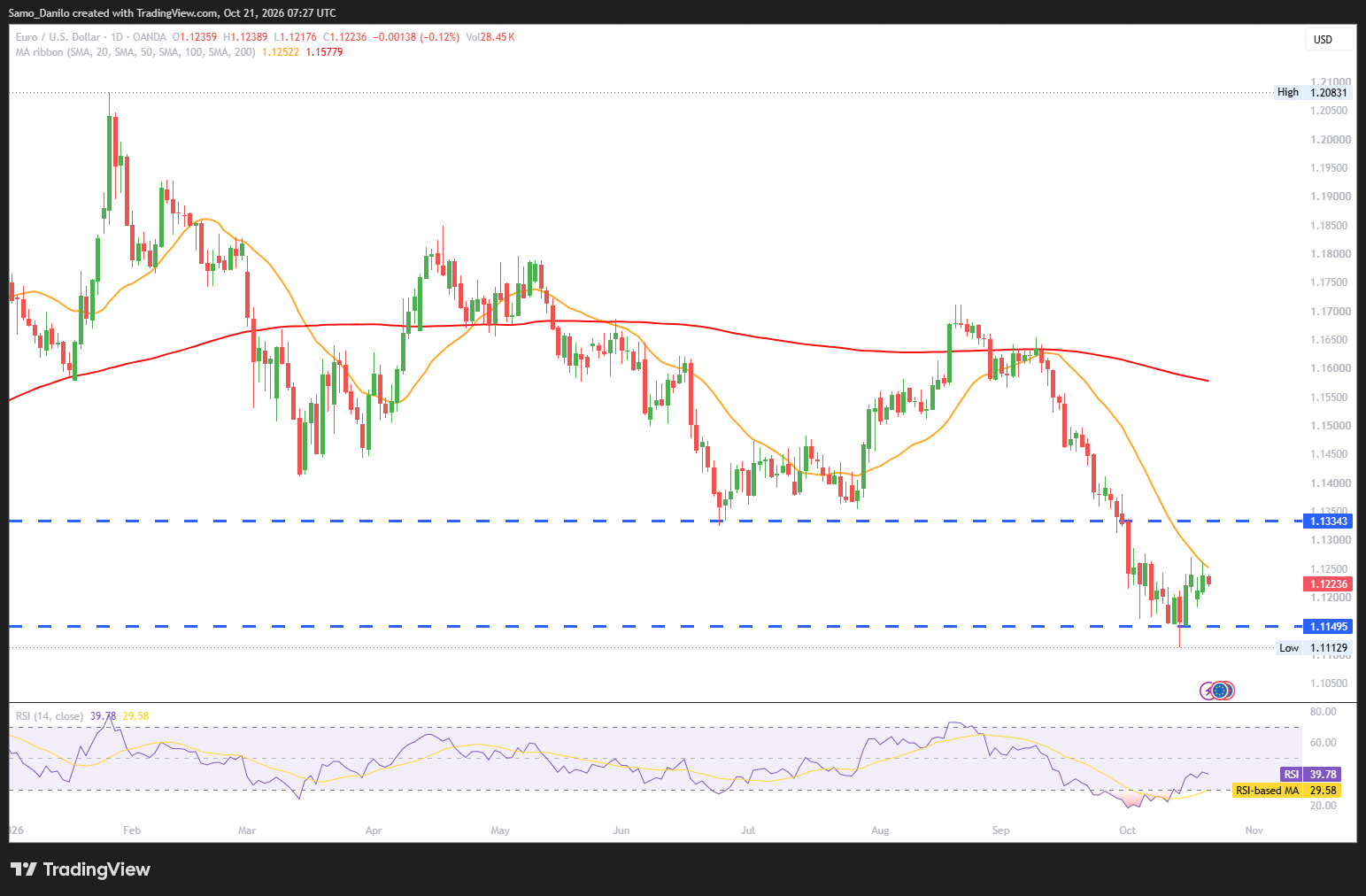
- EUR/USD Price: The EUR/USD pair is trading on a softer note near 1.1220 during the early European session on Wednesday.
- French protests: France plans to reinforce police with military personnel and launch a major security operation ahead of further protests scheduled for Saturday, following criticism of the government’s response to the previous weekend’s violence, according to Reuters. Prime Minister Sébastien Lecornu also said additional curfews would be imposed where necessary.
- Analysts outlook: Handelsbanken FX strategist Tommy von Brömsen said concerns surrounding France were unlikely to disappear soon, adding that the negative outlook for the country could persist and that further euro weakness had yet to be fully priced in.
- ECB rate: The European Central Bank is expected to leave its policy rates unchanged at its meeting on Thursday, October 29, with the deposit rate forecast to remain at 2.50%, in line with consensus expectations and market pricing.
- ECB policymakers: Investors will monitor speeches from ECB President Christine Lagarde and policymakers Philip Lane, Joachim Nagel and Piero Cipollone later on Wednesday.
| SMA (20) | Falling |  | |
| RSI (14) | Slightly Falling | |
|
| MACD (12, 26, 9) | Slightly Falling | |
Closing statement: EUR/USD remains under pressure near 1.1220 as French political instability and fiscal concerns weigh on the euro. Expectations for the ECB to hold rates at 2.50% may limit the impact of the upcoming decision itself, shifting attention toward policymakers’ comments and forward guidance. Persistent concerns over France could leave the pair vulnerable to further declines, while a more hawkish ECB tone could offer some support to the euro.
GBPUSD
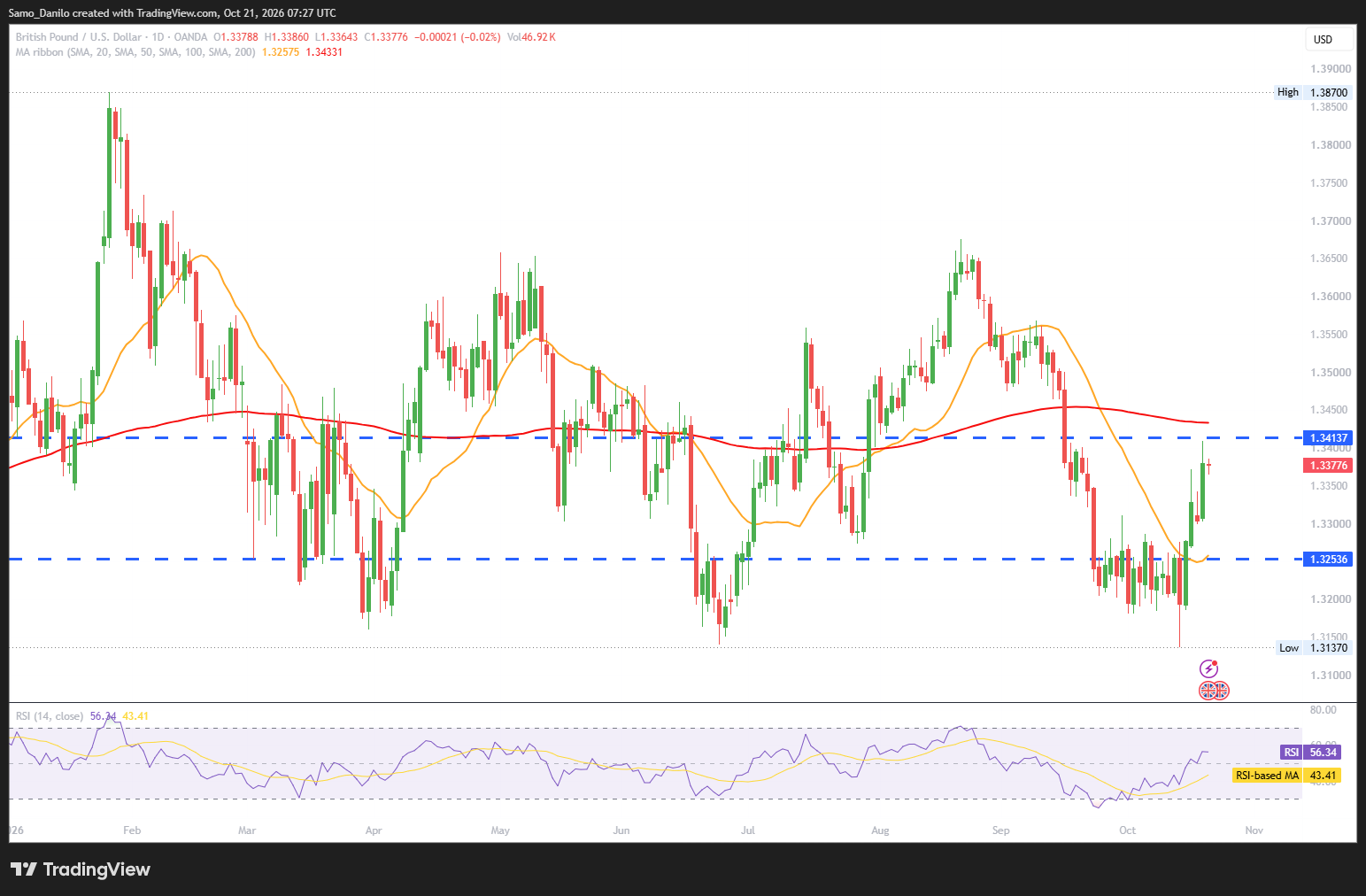
- GBP/USD Price: The GBP/USD pair is trading around 1.3380 after failing to break above the one-month high near 1.3400 on Tuesday.
- UK inflation: The UK headline Consumer Price Index (CPI) rose by 3.5% year-on-year in September, accelerating from 3.1% in August, according to the Office for National Statistics.
- UK borrowing: UK public sector net borrowing rose to £24.52 billion in September from £17.25 billion in August. The increase highlights mounting pressure on public finances and could weigh on sentiment toward the pound.
- Lanour market: ADP’s weekly employment growth measure recorded a notable decline, with employment falling for the first time since early August.
- UK data: The latest inflation figures follow Tuesday’s unexpected decline in the UK ILO unemployment rate to its lowest level in more than a year, alongside stronger GDP data released last week. These developments have reinforced market expectations that the Bank of England could raise interest rates at its November 5 meeting, potentially providing additional support for sterling.
| SMA (20) | Falling | | |
| RSI (14) | Slightly Rising |  |
|
| MACD (12, 26, 9) | Slightly Rising | |
Closing statement: GBP/USD is trading near 1.3380 after failing to break the 1.3400 resistance level, with stronger UK inflation and resilient labour market data supporting expectations of a Bank of England rate hike in November. However, rising public sector borrowing presents a potential headwind for the pound, while signs of cooling US employment could weigh on the dollar if confirmed by further data. A sustained break above 1.3400 could open the way for further gains, whereas continued rejection at resistance may leave the pair vulnerable to a pullback.
XAUUSD
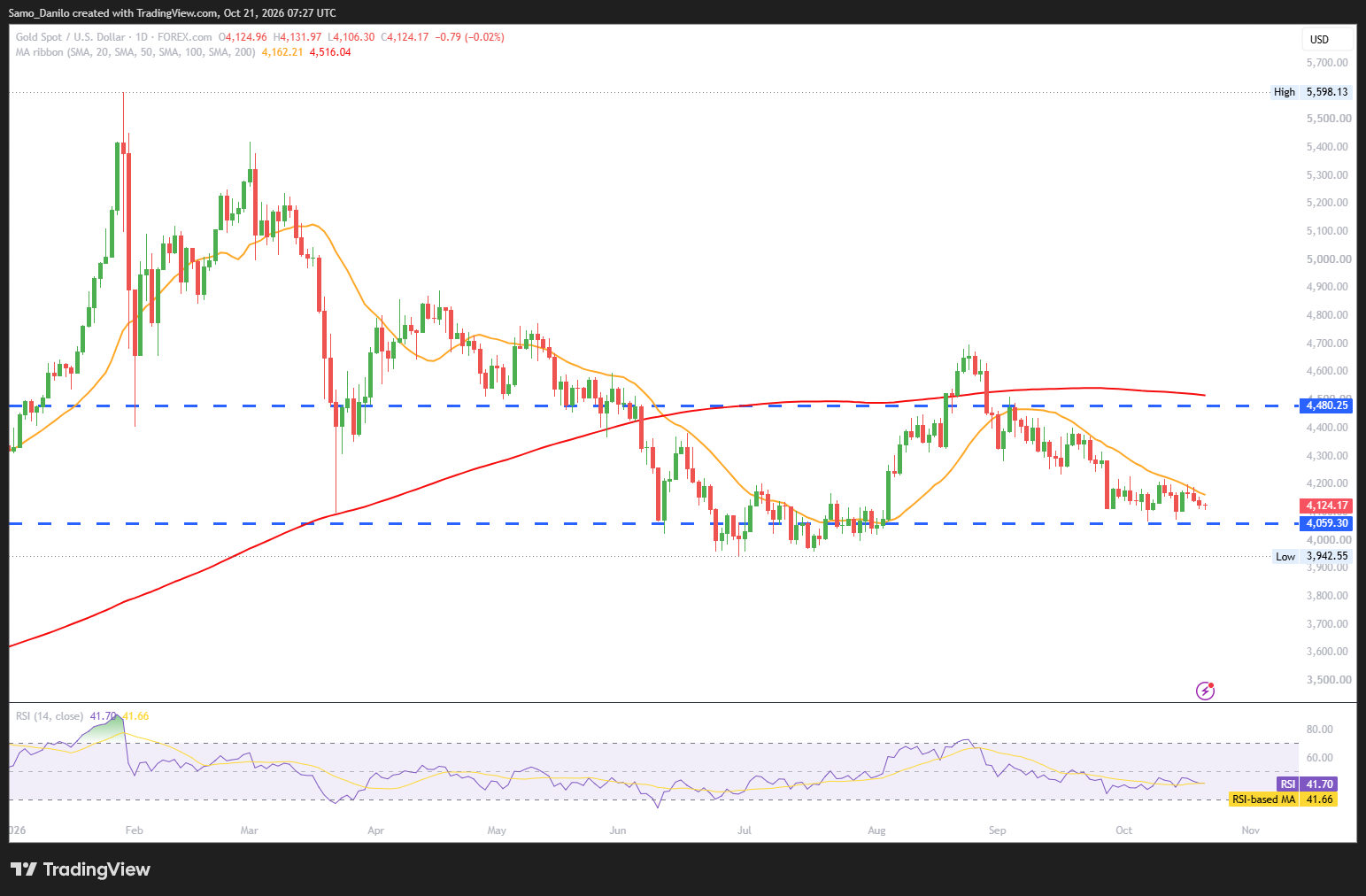
- XAU/USD Price: XAU/USD maintains a bearish tone heading into the European session on Wednesday, trading near the weekly low reached earlier in the day. Sellers are waiting for a sustained break below the $4,100 level before positioning for further declines, making this threshold a key technical level to watch.
- Fed rate: According to the CME Group’s FedWatch Tool, traders are pricing in a probability of more than 90% that the Federal Reserve will raise interest rates again in December.
- US-China: China’s Commerce Ministry opposed a US order concerning DeepSeek, stating that Beijing would take necessary measures to defend its interests and arguing that the action disregarded an understanding reached between the two countries’ leaders.
- Peace proposal: US envoy Steve Witkoff is expected to present a peace proposal to Russian President Vladimir Putin following talks with Ukrainian President Volodymyr Zelensky. Reports indicate that Witkoff will travel to St. Petersburg for discussions with Putin, potentially raising hopes for progress toward ending the conflict.
- Secretary Bessent: US Treasury Secretary Scott Bessent said recent Treasury bond auctions had been strong and that he did not see spillover effects from France’s financial and political situation.
| SMA (20) | Slightly Falling | |
| RSI (14) | Slightly Falling | |
| MACD (12, 26, 9) | Slightly Falling | |
Closing statement: Gold remains vulnerable near its weekly lows, with the $4,100 level representing a key downside threshold. Expectations of a December Fed rate hike are a significant headwind, as higher interest rates could support the dollar and Treasury yields. However, escalating US-China tensions may generate safe-haven demand, while progress toward a Russia-Ukraine peace agreement could reduce geopolitical support for bullion. A sustained break below $4,100 would strengthen the bearish outlook, whereas renewed geopolitical uncertainty could help gold stabilize.
CRUDE OIL
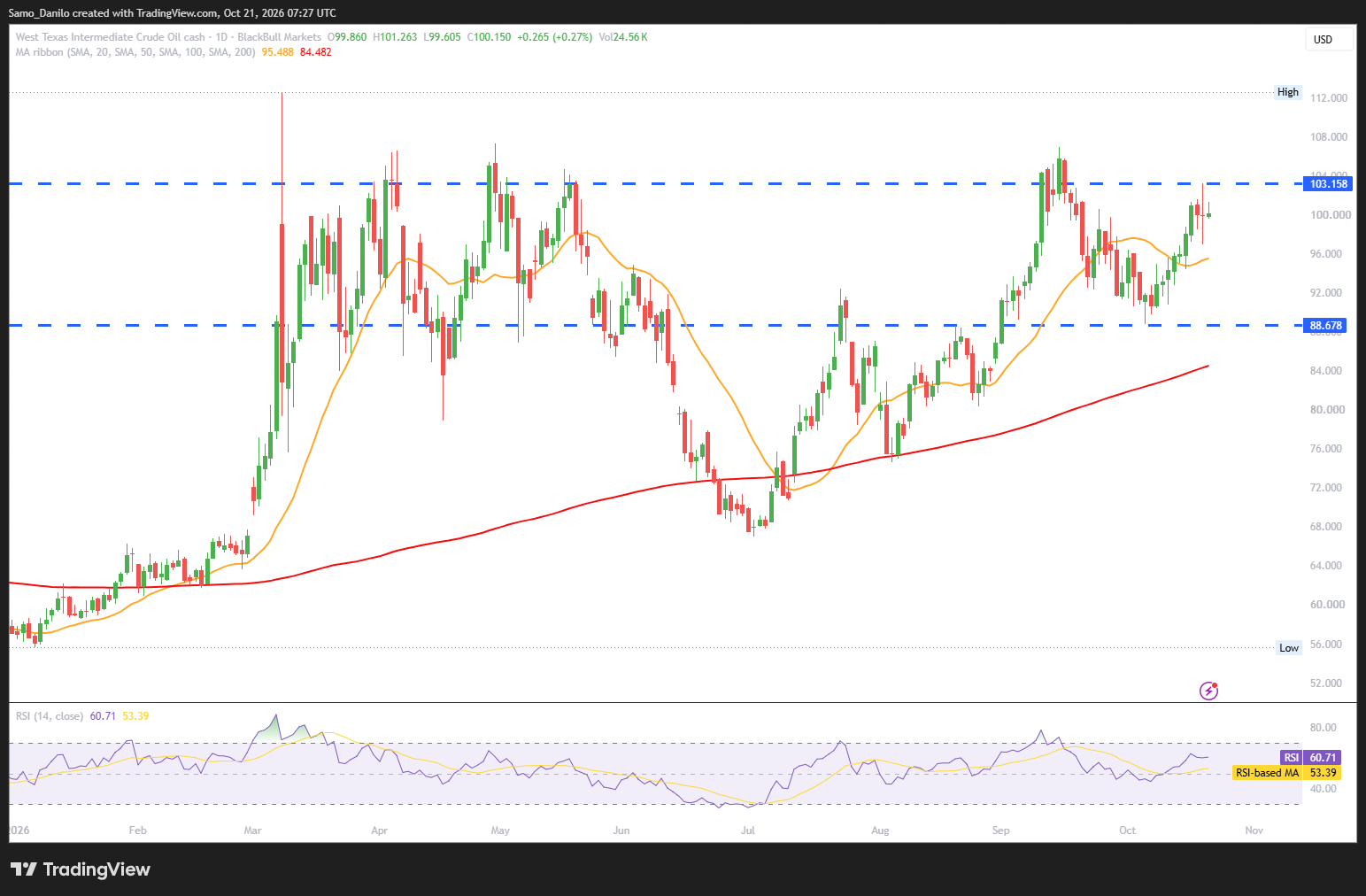
- Crude Oil Price: West Texas Intermediate (WTI), the benchmark US crude oil price, attracted fresh buyers during Wednesday’s Asian session but struggled to extend its gains beyond the $100.00 level.
- Compromise possibility: An unconfirmed report suggested that Qatar and Pakistan had proposed a compromise plan to the United States and Iran that could satisfy both sides. However, Bloomberg later reported that a diplomat involved in the negotiations disputed claims that an agreement was close, leaving uncertainty over whether diplomatic progress will ease tensions and reduce the risk premium in oil prices.
- Conditions requirement: Iranian state media reported that Parliament Speaker Mohammad Bagher Ghalibaf told Pakistan’s Army Chief, Asim Munir, that Tehran could not trust Washington without the fulfilment of its previously stated conditions.
- Strait of Hormuz: Iran’s First Vice President said the country had no choice but to exercise sovereignty over the Strait of Hormuz, intensifying concerns about potential disruptions to crude oil supplies.
- IEA chief: International Energy Agency (IEA) Chief Fatih Birol said the agency would consider releasing additional oil from emergency reserves if necessary.
| SMA (20) | Slightly Rising | |
|
| RSI (14) | Rising | | |
| MACD (12, 26, 9) | Slightly Rising | |
Closing statement: WTI has rebounded from its weekly low but continues to face resistance around $100 per barrel as markets weigh supply risks against the possibility of diplomatic progress. Uncertainty over US-Iran negotiations and Iran’s position on the Strait of Hormuz could sustain upward pressure if disruptions persist. However, a credible agreement or additional emergency oil releases by the IEA could ease supply concerns and trigger a pullback. The near-term outlook remains highly dependent on developments in the Middle East and the security of global oil flows.
DAX
- DAX 40 Price: The DAX 40 is trading higher at around 25,330 points on Tuesday morning.
- ZEW survey: Germany’s ZEW survey for October showed that the assessment of the current economic situation improved to -35.9, significantly outperforming expectations of -44.5 and the previous reading of -47.1. However, the economic expectations index declined more than anticipated to 28.1 from 34.7, compared with a consensus forecast of 30.0, suggesting that confidence in the near-term outlook has weakened despite improvements in current conditions.
- French budget: France’s negotiations over the 2026 budget are dragging on after a vote on the revenue side was postponed, with more than 2,800 of the 3,400 amendments still awaiting examination.
- Potential summit: According to Politico, the Trump administration is reportedly considering offering Russian President Vladimir Putin an in-person trilateral meeting with US President Donald Trump and Ukrainian President Volodymyr Zelenskiy.
- ECB’s Lane: European Central Bank Chief Economist Philip Lane said that a greater international role for the euro could help the ECB control prices, according to comments made during a panel discussion.
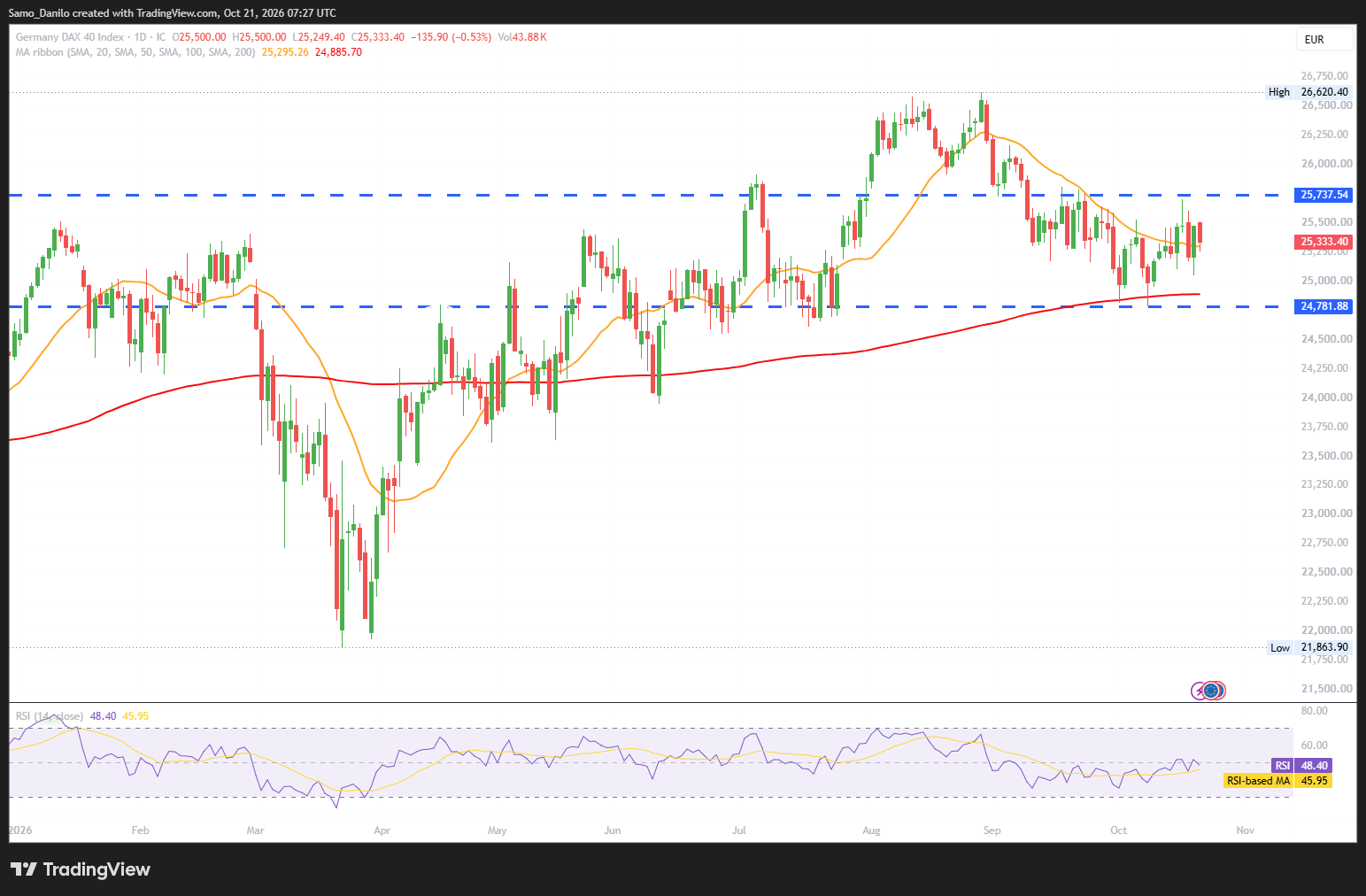
| SMA (20) | Slightly Falling | |
| RSI (14) | Slightly Falling | |
| MACD (12, 26, 9) | Slightly Falling | |
Closing statement: The DAX 40 is trading higher near 25,330 points, supported by a stronger assessment of Germany’s current economic conditions. However, the decline in ZEW expectations and ongoing French budget negotiations highlight persistent economic and political risks across Europe. Potential progress toward a meeting between Trump, Putin and Zelenskiy could improve sentiment if it raises hopes for peace, while the index’s near-term direction will also depend on incoming economic data and the broader European policy outlook.